


Fiber Optics: Understanding the Basics
Nothing has changed the world of communications as much as the development and implementation of optical fiber. This article provides the basic principles needed to work with this technology.
Engineering and Marketing Staff
Optical fibers are made from either glass or plastic. Most are roughly the diameter of a human hair, and they may be many miles long. Light is transmitted along the center of the fiber from one end to the other, and a signal may be imposed. Fiber optic systems are superior to metallic conductors in many applications. Their greatest advantage is bandwidth. Because of the wavelength of light, it is possible to transmit a signal that contains considerably more information than is possible with a metallic conductor - even a coaxial conductor. Other advantages include:
• Electrical Isolation - Fiber optics do not need a grounding connection. Both the transmitter and the receiver are isolated from each other and are therefore free of ground loop problems. Also, there is no danger of sparks or electrical shock.
• Freedom from EMI - Fiber optics are immune to electromagnetic interference (EMI), and they emit no radiation themselves to cause other interference.
• Low Power Loss - This permits longer cable runs and fewer repeater amplifiers.
• Lighter and Smaller - Fiber weighs less and needs less space than metallic conductors with equivalent signal-carrying capacity.
Copper wire is about 13 times heavier. Fiber also is easier to install and requires less duct space.
Applications
Some of the major application areas of optical fibers are:
• Communications - Voice, data, and video transmission are the most common uses of fiber optics, and these include:
– Telecommunications
– Local area networks (LANs)
– Industrial control systems
– Avionic systems
– Military command, control, and communications systems
• Sensing - Fiber optics can be used to deliver light from a remote source to a detector to obtain pressure, temperature, or spectral information. The fiber also can be used directly as a transducer to measure a number of environmental effects, such as strain, pressure, electrical resistance, and pH. Environmental changes affect the light intensity, phase and/or polarization in ways that can be detected at the other end of the fiber.
• Power Delivery - Optical fibers can deliver remarkably high levels of power for tasks such as laser cutting, welding, marking, and drilling.
• Illumination - A bundle of fibers gathered together with a light source at one end can illuminate areas that are difficult to reach - for example, inside the human body, in conjunction with an endoscope. Also, they can be used as a display sign or simply as decorative illumination.
Figure 1. An optical fiber consists of a core, cladding, and coating.

Construction
An optical fiber consists of three basic concentric elements: the core, the cladding, and the outer coating (Figure 1).
The core is usually made of glass or plastic, although other materials are sometimes used, depending on the transmission spectrum desired.
The core is the light-transmitting portion of the fiber. The cladding usually is made of the same material as the core, but with a slightly lower index of refraction (usually about 1% lower). This index difference causes total internal reflection to occur at the index boundary along the length of the fiber so that the light is transmitted down the fiber and does not escape through the sidewalls.
Figure 2. A beam of light passing from one material to another of a different index of refraction is bent or refracted at the interface.

The coating usually comprises one or more coats of a plastic material to protect the fiber from the physical environment. Sometimes metallic sheaths are added to the coating for further physical protection.
Optical fibers usually are specified by their size, given as the outer diameter of the core, cladding, and coating. For example, a 62.5/125/250 would refer to a fiber with a 62.5-µm diam core, a 125-µm diam cladding, and a 0.25-mm diam outer coating.
There are 81 suppliers of Fiber Optic Fibers in the Photonics Marketpla
Principles
Optical materials are characterized by their index of refraction, referred to as n. A material's index of refraction is the ratio of the speed of light in a vacuum to the speed of light in the material. When a beam of light passes from one material to another with a different index of refraction, the beam is bent (or refracted) at the interface (Figure 2).
Refraction is described by Snell's law:
where nI and nR are the indices of refraction of the materials through which the beam is refracted and I and R are the angles of incidence and refraction of the beam. If the angle of incidence is greater than the critical angle for the interface (typically about 82° for optical fibers), the light is reflected back into the incident medium without loss by a process known as total internal reflection (Figure 3).
Figure 3. Total internal reflection allows light to remain inside the core of the fiber.

Watch a video definition of total internal reflection.
Modes
When light is guided down a fiber (as microwaves are guided down a waveguide), phase shifts occur at every reflective boundary. There is a finite discrete number of paths down the optical fiber (known as modes) that produce constructive (in phase and therefore additive) phase shifts that reinforce the transmission. Because each mode occurs at a different angle to the fiber axis as the beam travels along the length, each one travels a different length through the fiber from the input to the output. Only one mode, the zero-order mode, travels the length of the fiber without reflections from the sidewalls. This is known as a single-mode fiber. The actual number of modes that can be propagated in a given optical fiber is determined by the wavelength of light and the diameter and index of refraction of the core of the fiber.
There are several causes of attenuation in an optical fiber:
• Rayleigh Scattering - Microscopic-scale variations in the index of refraction of the core material can cause considerable scatter in the beam, leading to substantial losses of optical power. Rayleigh scattering is wavelength dependent and is less significant at longer wavelengths. This is the most important loss mechanism in modern optical fibers, generally accounting for up to 90% of any loss that is experienced.
• Absorption - Current manufacturing methods have reduced absorption caused by impurities (most notably water in the fiber) to very low levels. Within the bandpass of transmission of the fiber, absorption losses are insignificant.
• Bending - Manufacturing methods can produce minute bends in the fiber geometry. Sometimes these bends will be great enough to cause the light within the core to hit the core/cladding interface at less than the critical angle so that light is lost into the cladding material. This also can occur when the fiber is bent in a tight radius (less than, say, a few centimeters). Bend sensitivity is usually expressed in terms of dB/km loss for a particular bend radius and wavelength.
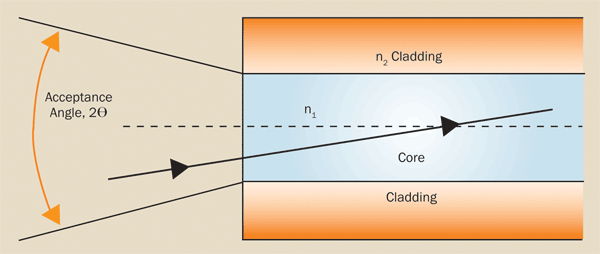
Figure 4. Numerical aperture depends on the angle at which rays enter the fiber and on the diameter of the fiber's core.
Fiber types
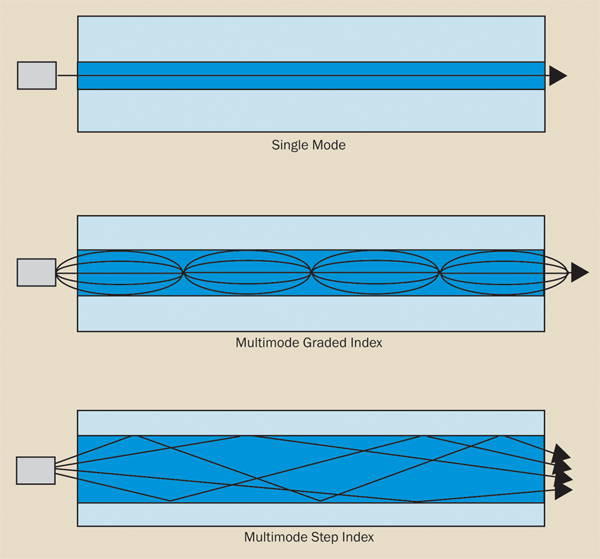
There are basically three types of optical fiber: single mode, multimode graded index, and multimode step-index. They are characterized by the way light travels down the fiber and depend on both the wavelength of the light and the mechanical geometry of the fiber. Examples of how they propagate light are shown in Figure 5.
Our company specializes in the production of plastic optical fibers/cables and all kinds of fiber optic patch cords, if you are interested, please feel free to contact me.
Jiangsu TX Plastic Optical Fibers Co., Ltd
Website: https://www.fibretx.com/
Contact : Jojo Leng
Email : yy@txpof.com
Mobile/Wechat: +86-19505282862
Whatsapp:+0086-19505282862


