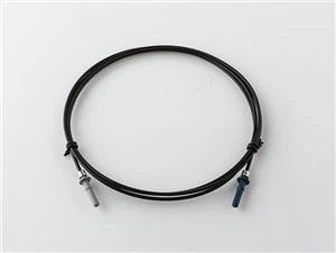
What Is High Temperature Resistance Plastic Optical Fiber Cable (POF Cable)?
- Key Issues
1. Is it a momentary high temperature or a prolonged high temperature?
Many customers only describe the working conditions as "high ambient temperature." However, the most crucial question in engineering is that is it a short-term temperature rise or a long-term continuous high-temperature state?
PMMA plastic optical fibers typically have a higher tolerance for short-term thermal shock than for prolonged continuous high temperatures. The real factor affecting lifespan is the cumulative effect of sustained temperature and time.
2. Is the heat source from the environment or the light source?
These two situations are completely different. If the ambient temperature is high, the problem is relatively controllable. If a high-power light source is directly close to the end face, the risk is much greater.
In actual projects, localized heat accumulation at the light source end is often more critical than ambient temperature. Many "high-temperature resistant models" fail because the light source design is not optimized.
3. Is there a superposition of mechanical stress?
High temperature itself is not terrible; what is terrible is: high temperature + small radius bending, high temperature + tension, high temperature + frequent vibration.
When multiple stresses are superimposed, the aging rate will be significantly accelerated. When selecting a component, don't just look at the temperature; consider the overall operating conditions.
- Key Selection Points
1. Don't Just Look at the Nominal Temperature Resistance
The nominal temperature resistance usually refers to the material's extreme range. What you really need to focus on is: the recommended long-term operating temperature range, the attenuation trend with temperature, and the estimated lifespan at the target temperature. The more extreme the parameters, the more cautious you should be.
2. Pay Attention to Transmittance and Attenuation Stability
In high-temperature environments, the first change is usually not breakage, but rather: decreased transmittance and increased attenuation rate. If the system is sensitive to brightness requirements, optical stability must be prioritized, rather than just focusing on mechanical performance.
3. Coordinate with System Heat Dissipation Design
Practical experience shows that improving the heat dissipation structure is more effective than simply upgrading materials. This includes: increasing the distance between the light source and the fiber optic cable, using heat insulation structures, and optimizing the light source power matching. In many cases, a reasonable structural design can solve "high-temperature anxiety."
- Common Selection Misconceptions
**Misconception 1: The higher the temperature resistance, the better**
Higher temperature resistance ratings often mean increased costs, more difficult processing, and potential changes in certain optical properties. If the actual environment doesn't require extreme temperature resistance, blindly upgrading will only increase costs.
**Misconception 2: All PMMA are the same**
Even with the same nominal PMMA material, different manufacturers differ in raw material control, additive systems, and production processes. Differences in internal structural stability will lead to different performance in high-temperature environments. When selecting materials, focus on production stability, not just the material name.
**Misconception 3: The problem must be with the material**
Extensive project reviews have revealed that common causes of failure include: light source power exceeding the matching range, poor end-face bonding leading to localized overheating, and small-radius bending combined with thermal environments. The material merely bears the consequences. System design is fundamental.
The selection of high-temperature resistant plastic optical fibers is essentially a system matching issue, not a material race. Materials have physical boundaries; this is an objective law. The truly mature approach is to first assess the actual working conditions, then match a suitable model, and finally optimize the structural design. When these three factors are properly matched, the high-temperature resistance problem can be controlled.
Please send me an inquiry for more information if you have any interests and demends.
Contact person: Freya Shao
E-mail address: yll@txpof.com
Phone/Whatsapp: +86 19505282863
Wechat: Freya-TXPOF
Web: http://www.fibretx.com