Application Analysis of Plastic Optical Fiber (POF) in Servo Motor Systems
In industrial automation, Plastic Optical Fiber (POF) has become a critical transmission medium for high-speed data communication between servo motors and drives, such as encoder feedback and bus control. Compared to traditional copper shielded cables and silica glass optical fibers, POF exhibits unique advantages and limitations in the complex electromagnetic and mechanical environments of servo systems. Below is a comprehensive analysis of POF applications in servo motors.
1. Overview
Plastic Optical Fiber (POF) leverages its distinct physical properties to serve as a key medium for high-speed serial communication links. It offers significant differentiated benefits over copper and glass fiber, particularly in dynamic industrial settings.
2. Core Advantages
2.1 Complete Immunity to Electromagnetic Interference (EMI/RFI)
The Challenge: The high-frequency switching of inverters (PWM modulation) generates intense electromagnetic harmonics and noise.
Copper Cable Pain Point: Even with double shielding, copper cables are susceptible to crosstalk in long-distance runs or cable chains (drag chains), leading to encoder pulse loss or system errors.
POF Advantage: Utilizing light for signal transmission, POF is inherently immune to electromagnetic, radio frequency, and high-voltage electric fields (100% EMI immunity). It eliminates the need for strict separation distances from power cables, significantly enhancing system stability.
2.2 Superior Flexibility and Bend Radius (Drag Chain Adaptability)
The Challenge: Servo motors on robotic arms, CNC machines, or linear slides require cables to withstand millions of dynamic bending and torsion cycles.
Glass Fiber Pain Point: Silica fibers are brittle, have large minimum bend radii, and are prone to fatigue fractures.
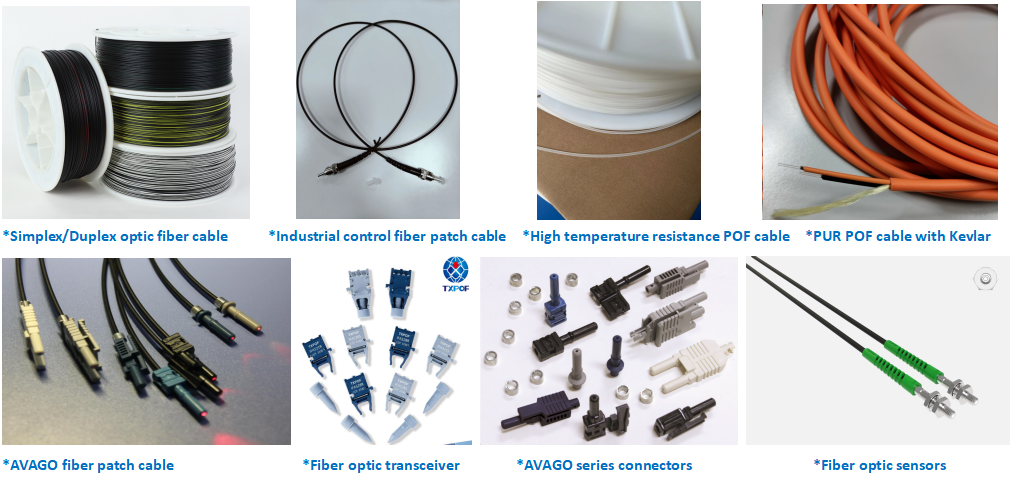
POF Advantage: POF (typically with a PMMA core) offers exceptional toughness, with a minimum bend radius as low as 20mm. When combined with high-flexibility PUR (Polyurethane) or PVC sheathing, it is ideally suited for high-frequency drag chain applications.
2.3 Simplified Field Termination and Lower Total Cost of Ownership (TCO)
The Challenge: Terminating glass fiber requires expensive fusion splicers and highly skilled technicians.
POF Advantage: With a large core diameter (0.5mm to 1.0mm), POF does not require fusion splicing. Installation involves simply cutting the fiber square with a dedicated tool, polishing the end-face, and snapping it into a molded connector. This drastically reduces labor costs and simplifies on-site maintenance.

3. Typical Application Scenarios
3.1 Servo Encoder Feedback Loop
Function: Transmission of high-speed serial data from high-precision absolute encoders (supporting protocols such as EnDat, BiSS, and Tamagawa).
Value: Prevents signal distortion caused by electromagnetic noise, thereby eliminating risks of "runaway" motors or positioning drift, ensuring precise closed-loop control.
3.2 Industrial Bus Control (Bus-Based Servo Systems)
Function: Topology connections within Industrial Ethernet networks (SERCOS III, PROFINET, EtherCAT) linking PLCs to drives or drives to drives.
Value: Facilitates microsecond-level high-speed synchronization and simplifies cabling architecture in complex machinery.
With over a decade of expertise in Plastic Optical Fiber (POF), we are a core domestic supplier in the industrial servo fiber optics sector. We welcome inquiries from interested parties.
Contact:
Jiangsu TX Plastic Optical Fibers Co., Ltd
Website: https://www.fibretx.com/
Contact person: Jojo.Leng
Mobile/Wechat: +86-19505282862
Whatsapp:+0086-19505282862