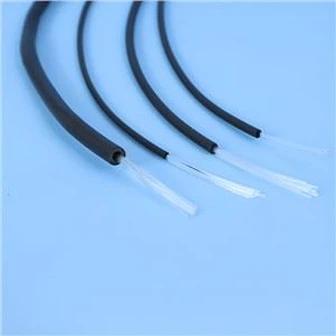
Technical Review of Plastic Optical Fiber (POF)
1. Introduction
Plastic Optical Fiber (POF) is a type of optical fiber fabricated from polymer materials for optical signal transmission, operating on the principle of total internal reflection of light. As one of the two major optical fiber categories alongside silica glass optical fiber, POF features outstanding flexibility, light weight, simple processing and termination. It also inherits the inherent advantages of optical transmission: immunity to electromagnetic interference, low signal leakage and high communication security. POF serves as an optimal solution for short-range optical interconnection scenarios.

2. Structural Composition of Plastic Optical Fiber
POF adopts a layered optical waveguide design. The basic bare fiber consists of core, cladding and coating. For finished cables, an additional outer jacket is applied, forming a four-layer structure.
2.1. Core (Core)
The light transmission core of POF, commonly made of high-refractive-index transparent polymer materials. Polymethyl methacrylate (PMMA, acrylic) is widely adopted for conventional POF, while perfluorinated polymer is used for high-performance POF. The core is the primary path for light propagation. The core diameter of POF ranges from 0.25 mm to 1 mm, which is significantly larger than the 9 μm core of single-mode silica fiber. The large core greatly improves optical coupling tolerance and lowers the technical threshold for field alignment.
2.2. Cladding (Cladding)
The cladding wraps around the outer surface of the core and is made of transparent polymer with a lower refractive index than the core. The refractive index difference between core and cladding forms an optical reflection boundary, confining optical signals inside the core for propagation.
2.3. Coating Layer (Coating)
A polymer resin coating that provides moisture resistance, scratch resistance and mechanical buffering. It protects the core-cladding assembly from microcracks and environmental moisture, improving the mechanical stability of optical fiber.

3. Key Performance Characteristics
3.1 Advantages
Easy Termination and Convenient Installation Benefiting from its large core diameter, POF has high tolerance for optical coupling. No fusion splicer is required. Simple connectors or end-face cutting can complete interconnection, which reduces equipment investment and technical barriers for field deployment.
Superior Flexibility and Vibration Resistance Made of polymer materials, POF can endure small-radius bending and continuous vibration without fracture. It is suitable for internal wiring of equipment and connection of moving components.
Electromagnetic Interference Immunity & High Communication Security Since signals are transmitted by light, POF is completely immune to electromagnetic noise generated by motors, frequency converters and high-voltage cables. Optical signals do not radiate outward, making interception difficult. It is well-suited for industrial environments with strong electromagnetic interference.
Light Weight and Controllable Raw Material Cost The density of polymer substrate is much lower than glass, resulting in lightweight cables. Raw material cost is competitive for mass production.
3.2 Limitations
High Transmission Loss and Limited Transmission Distance Polymer materials exhibit strong light absorption. Acceptable performance can be achieved in the visible light band, while the loss in infrared band is substantially higher than silica fiber. Typical PMMA POF supports effective transmission over only tens of meters, far shorter than silica fiber capable of transmission for tens of kilometers. Therefore, POF is only applicable to short-range communication.
Restricted Temperature Resistance Ordinary PMMA POF has a narrow operating temperature range. It tends to age and deform under high temperature and is only applicable to ambient-temperature scenarios. Perfluorinated POF delivers improved temperature resistance at a much higher material cost.
Limited Bandwidth Capacity Most POF falls into the multimode category with obvious modal dispersion. Its bandwidth for high-speed transmission is inferior to single-mode silica fiber, so it is not applicable for long-distance, ultra-high-speed backbone transmission.

4. Application Scenarios
POF is positioned for short-range transmission and will not replace silica fiber for long-distance communication. Its major application fields are listed below:
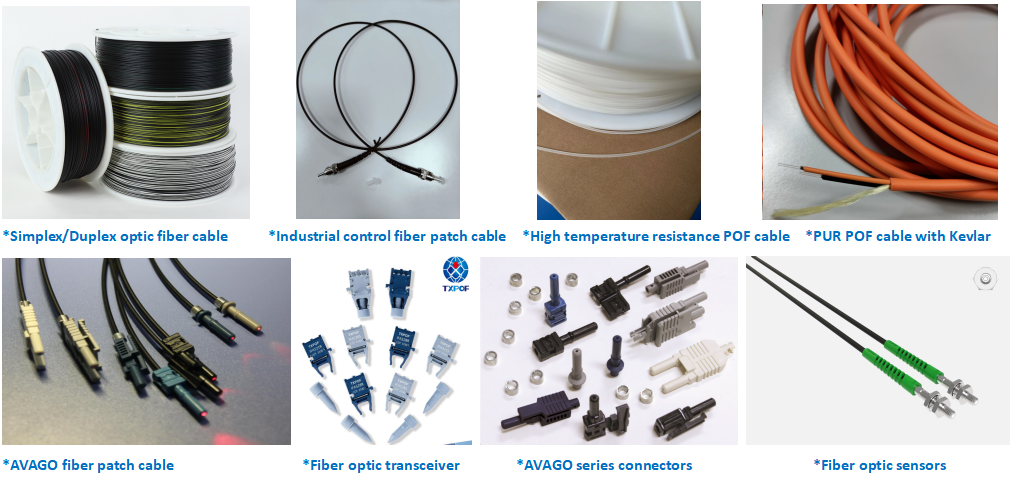
Industrial Automation Industrial field bus, signal transmission for frequency converters and sensors. In factories with high-voltage and motor equipment, POF isolates electromagnetic interference and realizes reliable signal interconnection between devices.
Automotive Communication In-vehicle multimedia, lighting and sensor signal transmission. It features vibration resistance and lightweight, adapting to wiring in confined space inside vehicles.
Consumer Electronics & Smart Home Signal connection inside household appliances and short-range audio & video transmission in buildings.
Optical Sensing & Light Guidance Optical sensing, landscape light transmission and light guiding in medical devices. It separates light sources from the working end by conducting light.
Security and Rail Transit Signal links inside carriages and short-range signal transmission for security equipment.
Contact:
Jiangsu TX Plastic Optical Fibers Co., Ltd
Website: https://www.fibretx.com/
Att: Jojo.Leng
Mobile/Wechat: +86-19505282862
Whatsapp:+0086-19505282862