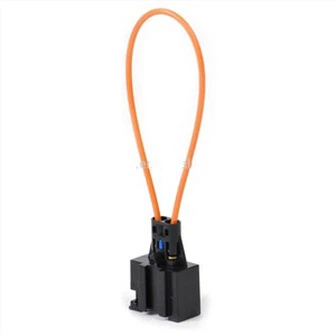
What Are the Properties of Plastic Optical Fiber Cable?
The performance of plastic optical fiber cable can be evaluated from multiple aspects. The following are some key performance characteristics:
I. Transmission performance
1. Bandwidth: The bandwidth capacity of plastic optical cables may be smaller than that of quartz optical fibers, but it can still meet the data transmission needs within a certain range. Gradient plastic optical fibers can suppress mode dispersion to a certain extent and maintain a larger numerical aperture through reasonable refractive index distribution design, thereby controlling the broadening effect of the outgoing light wave relative to the incident light wave and improving the transmission bandwidth. However, it should be noted that the bandwidth of plastic optical fibers is still affected by factors such as material dispersion.
2. Attenuation: The attenuation of plastic optical fibers mainly depends on the scattering loss and absorption loss of the material. For plastic optical cables, their attenuation performance will directly affect the transmission distance and quality of optical signals. The attenuation of communication-grade plastic optical fibers should be as low as possible to ensure that the loss of optical signals during transmission is minimized.
II. Physical properties
1. Diameter and flexibility: The diameter of plastic optical cables is usually small, which is convenient for threading and construction in a small space. At the same time, due to the use of plastic materials, the optical cable has good flexibility, can be bent and twisted, and is suitable for wiring in complex environments.
2. Weight: Compared with traditional metal optical cables, plastic optical cables are lighter, easier to carry and install, and can also reduce the requirements for supporting structures.
III. Environmental adaptability
1. Heat resistance: The heat resistance of plastic optical cables is mainly determined by their material composition. The heat resistance of plastic optical cables may vary depending on the material, but in general, their heat resistance is relatively limited and can generally only be used within a specific temperature range. When the temperature exceeds this range, the performance of the optical cable may be affected.
2. Anti-interference: Plastic optical cables are not susceptible to electromagnetic interference and electromagnetic field interference, and can provide more stable signal transmission. This feature gives plastic optical cables a clear advantage in situations where stable data transmission is required.
IV. Connection and maintenance
1. Connectivity: Plastic optical cables are relatively simple to connect, do not require special tools, and can even be cut with simple scissors. This makes the wiring and maintenance of plastic optical cables more convenient and efficient.
2. Cost: Compared with quartz optical fibers, the total cost of plastic optical cables and their related connectors and installation is lower. This makes plastic optical cables have greater application potential in some cost-sensitive occasions.
In summary, plastic optical cables have certain advantages in transmission performance, physical properties, environmental adaptability, connection and maintenance. When choosing to use plastic optical cables, it is necessary to make comprehensive considerations based on specific application scenarios and needs.
Contact person: Freya Shao
E-mail address: yll@txpof.com
Phone/Whatsapp: +86 19505282863
Wechat: Freya-TXPOF
Web: http://www.fibretx.com