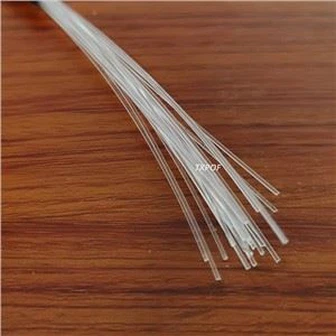
Plastic optical fiber material
The basic condition of the core and sheath material used for plastic optical fiber is good light transmittance, that is, the light transmittance of the polymer is required to be greater than 90%. The higher the light transmittance, the lower the transmission loss of the plastic optical fiber. Most of the polymers with good light transmittance are amorphous structures, isotropic, do not contain chromophore groups, and have a uniform refractive index [1]. As the core material, typical polymers are: polymethylmethacrylate (PMMA), polystyrene (PS), polycarbonate (PC).
Plastic optical fiber for communication
Plastic optical fiber is usually called "bare fiber". Because it is not protected by a coating, it is easily damaged. Therefore, the plastic optical fiber used for communication is actually a plastic optical fiber cable coated with plastic, just like copper cable and quartz used for communication. The same for optical cables. To transmit data, optical fiber (cable) must also form an optical transmission system with other parts. A typical optical transmission system consists of three parts. The working process of optical transmission is carried out between the optical transmitter, the optical fiber and the optical receiver. The optical transmitter converts the input electrical signal into an optical signal, and the converted optical signal is transmitted by the optical fiber to the receiving device-an optical receiver, and the optical receiver restores the optical signal obtained from the optical fiber to an electrical signal.
To realize optical fiber communication, an important issue is to reduce the transmission loss of the optical fiber as much as possible, so as to ensure that the optical fiber has a certain transmission distance. When light enters from one end of the fiber and exits from the other end, the intensity of the light will be weakened. This means that after the optical signal propagates through the optical fiber, the light energy is attenuated partly. This shows that there are certain substances in the optical fiber or for some reason, blocking the passage of optical signals, which is the transmission loss of the optical fiber. Only by reducing fiber loss can the optical signal flow unimpeded.
The main factors that cause optical fiber transmission loss (attenuation) are: intrinsic, bend, squeeze, impurities, unevenness and butt.
1) Intrinsic: It is the inherent loss of optical fiber, including: Rayleigh scattering, inherent absorption, etc.
2) Bending: When the fiber is bent, part of the light in the fiber will be lost due to scattering, causing loss.
3) Squeeze: Loss caused by slight bending when the optical fiber is squeezed.
4) Impurities: Impurities in the optical fiber absorb and scatter the light propagating in the optical fiber and cause losses.
5) Non-uniformity: Loss caused by non-uniform refractive index of fiber material.
6) Butt connection: loss caused by fiber butt, such as: different axis, end face is not perpendicular to the axis, uneven end face, mismatched butt core diameter and poor splicing quality, etc. Then the loss related to the material itself is the loss caused by the absorption and scattering of the light propagating in the optical fiber contained in the material. The loss of the optical fiber is expressed by the loss coefficient a, which is defined as the number of decibels of optical power loss per kilometer, in dB/km. At present, the low-loss plastic optical fiber that has been mass-produced in the international market refers to the plastic optical fiber with a loss of <200dB/km.