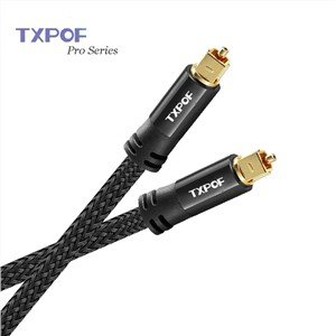
Plastic Optical Fiber (POF) cable
Plastic Optical Fiber (POF) cable is a type of optical fiber that is made from plastic materials instead of the traditional glass fibers. It is designed to transmit light signals for data communication, similar to glass optical fibers, but it has some distinct characteristics that make it suitable for specific applications.
Here are some key points about Plastic Optical Fiber cables:
Material Composition: POF cables are typically made from polymethylmethacrylate (PMMA), which is a type of plastic that has good optical properties for transmitting light signals. This material is much less expensive than the glass used in traditional optical fibers.
Core and Cladding: Like glass optical fibers, POF cables consist of a core and cladding. The core is the central part through which light is transmitted, while the cladding surrounds the core and helps contain the light within the core by using a lower refractive index. In POF cables, both the core and cladding are made of plastic materials.

Advantages:
Cost-Effective: One of the main advantages of POF cables is their cost-effectiveness. The materials used in POF cables are less expensive than the glass used in traditional optical fibers, making POF a more economical option for short-distance applications.
Easy Installation: POF cables are more flexible and durable compared to glass fibers. They can be easily bent, routed, and installed without the need for specialized tools or expertise, which can simplify installation and reduce associated costs.
Safety: POF cables are not as fragile as glass fibers and are considered safer in certain environments, such as homes or offices, where accidental breakage might occur.
Electromagnetic Interference (EMI) Immunity: POF cables are immune to electromagnetic interference, which makes them suitable for applications in electrically noisy environments where traditional copper cables might experience signal degradation due to EMI.
Limitations:
Bandwidth and Distance: POF cables have limited bandwidth and are best suited for relatively short-distance communication applications, typically up to around 100 meters. They are not well-suited for long-distance, high-bandwidth applications that glass optical fibers can handle.
Signal Loss: POF cables generally have higher signal loss (attenuation) compared to glass fibers. This limits their use in high-speed or long-distance applications.

Applications:
Home Networking: POF cables are commonly used in home networking environments where the distances are relatively short, and cost-effectiveness is important.
Industrial Networks: POF can be used in industrial settings where electromagnetic interference is a concern and where high bandwidth or long distances are not critical.
Automotive: POF cables have been used in automotive applications for communication within vehicles, offering a robust solution against EMI.
Decorative Lighting: POF lighting is often used for decorative purposes in interior and exterior spaces. It can be used to create unique and visually striking lighting effects in homes, commercial buildings, hotels, restaurants, and entertainment venues.
In conclusion, Plastic Optical Fiber cables offer a cost-effective and easy-to-install solution for short-distance communication applications. While they have limitations in terms of bandwidth and signal loss compared to glass optical fibers, they are suitable for specific scenarios where these limitations are not a significant concern.