Types and selection of cable jacketing materials
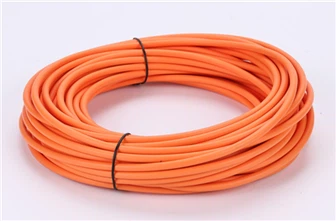
The cable jacket (also known as the outer jacket or sheath) is the outermost layer of a cable, fiber optic cable, or wire, and serves as the most important barrier in a cable to keep the internal structure safe and protect the cable from external heat, cold, moisture, UV rays, ozone, or chemical and mechanical damage during and after installation. Cable jackets are not intended to replace the reinforced defenses inside the cable, but they can provide a fairly high but limited level of protection. Sheathing also plays an important role in the durability of optical cables and wires.
There are many types of cable sheathing materials, commonly used cable sheathing materials are - cross-linked polyethylene (XLPE), polytetrafluoroethylene (PTFE), fluorinated ethylene propylene (FEP), perfluoroalkoxy resins (PFA), polyurethane (PUR), polyethylene (PE), thermoplastic elastomer (TPE) and Polyvinyl chloride (PVC), each of which has different performance characteristics.
The choice of raw materials for cable jacketing begins with environmental compatibility and compatibility with the connectors used. For example, extremely cold environments may require cable jacketing that remains flexible at very low temperatures. Choosing the right sheath material is critical to determining the best optical cable for each application. Therefore, it is important to know exactly what purpose the optical cable or wire must fulfill and what requirements it must meet.
The choice of sheath material may also be influenced by the following criteria:
1. Type of installation (fixed or flexible)
2. Type of movement (forced guiding, manual guiding, bending, twisting) -
3. Temperature range -
4. Abrasion, tensile and other mechanical stresses -
5. Chemical influences -
6. Water resistance -
7. UV resistance-
8. Oil resistance-
9. Halogen content, flame retardancy, and fire ratings-
10. Cleanroom Applications-
11. UL or other approvals and certifications

PVC Polyvinyl Chloride (PVC) is a commonly used cable sheathing material. Polyvinyl chloride is the base resin, add stabilizers, plasticizers and calcium carbonate and other inorganic fillers, additives and lubricants and other additives, after mixing and kneading and extrusion and the preparation of particles. It has good physical, mechanical and electrical properties, as well as good weather resistance and chemical stability, but also through the addition of different additives to improve its performance, such as flame retardant, heat-resistant, etc. PVC cable sheath production method is to add PVC particles to the extruder, extrusion molding at high temperatures and high pressures, the formation of tubular cable sheaths. The advantages of PVC cable sheath are cheap, easy to process and install, and widely applicable. It is commonly used in low-voltage cables, communication cables, building wires and other fields.
Polyethylene (PE Polyethylene) is a commonly used cable sheathing material. It has good mechanical properties and chemical stability, as well as good heat and cold resistance and weather resistance.PE cable sheath can be improved by adding additives to improve its performance, such as antioxidants, ultraviolet absorbers, etc. The production method of PE cable sheath is similar to that of PVC, which is to add PE particles to the extruder, and then extruded at high temperatures and high pressures, to form a tubular cable sheath.PE cable sheath has the advantages of good resistance to environmental aging and UV resistance, while the price is relatively low, widely used in fiber optic cable. The advantages of PE cable sheath are good environmental aging resistance and UV resistance, while the price is relatively low, widely used in fiber optic cables, low voltage cables, communication cables, mining cables and other fields.

Polyurethane thermoplastic elastomer (TPU) is a commonly used material for cable jacketing. Unlike polyurethane elastomer (PUR), TPU is a thermoplastic material with better processing performance and plasticity.
The TPU cable sheath has good abrasion resistance, oil resistance, acid and alkali resistance, and weather resistance, as well as good mechanical strength and elastic recovery properties, and is able to adapt to complex mechanical movement and vibration environments.
The production method of TPU cable sheath is to add TPU pellets into the extruder, extruded under high temperature and high pressure to form a tubular cable sheath.
TPU cable sheath is widely used in industrial automation, machine tool equipment, motion control systems, robots and other fields, as well as automotive, marine and other fields. It has good abrasion resistance and elastic recovery properties, which can effectively protect cables, and also has excellent high temperature resistance and low temperature resistance.
Our company specializes in the production of plastic optical fibers and cables, and has more than ten years of experience in this industry. Most of the fiber optic cables made are made of the above mentioned materials. If you are interested, please feel free to contact us.
Contact :
Jiangsu TX Plastic Optical Fibers Co., Ltd
Website: www.txpof.com/en/
Contact : Jojo Leng
Email : yy@txpof.com
Mobile/Wechat: +86-19505282862
Whatsapp:+0086-19505282862